How to teach multiplication
Learning the times tables is a big step for every child. Some kids pick it up in a few weeks. Others need a lot more time, and that is completely normal. On this page we share what really helps, from the very first idea of "groups of" to knowing every fact by heart.
When do kids learn multiplication?
In most US schools, kids start with multiplication in 2nd or 3rd grade. By the end of 3rd grade, the goal is to know the basic facts up to 10 × 10 by heart. In 4th grade they move on to bigger numbers, and many schools add the 11 and 12 times tables too.
Every child learns at their own speed. If your child needs a bit longer, don't worry. A few minutes of practice at home makes a big difference.
Start with understanding
Before kids learn the facts by heart, it helps to understand what multiplication means. 3 × 4 is simply three groups of four. You can show that with almost anything: three plates with four grapes on each, or three rows of four Lego bricks. Count them together and you get 12.
That is also why 3 × 4 is the same as 4 + 4 + 4. Once kids see this, multiplication is no longer a list of random numbers. It becomes something they can work out themselves, even on a day when they forget an answer.
The best order to learn the times tables
Don't start at 1 and work your way up to 12. Start with the tables that have the easiest patterns:
Step 1: the 1, 2, 5 and 10 times tables. Times 1 changes nothing. Times 2 is doubling. The 5s always end in 5 or 0, and times 10 just adds a zero.
Step 2: the 3, 4 and 11 times tables. The 4s are the 2s doubled, and the 11s up to 11 × 9 are just the number written twice: 33, 44, 55.
Step 3: the 6, 7, 8, 9 and 12 times tables. These feel the hardest, but by now your child already knows most of them. 7 × 3 is the same as 3 × 7, which they learned in step 2.
Every table has its own page with practice and a handy trick, for example the 9 times table with the finger trick.
Multiplication strategies that make it easier
Turn it around. 7 × 3 is the same as 3 × 7. In math this is called the commutative property of multiplication. Kids don't need the name, but knowing that every fact works both ways cuts the work almost in half.
Double it. The 4s are the 2s doubled and the 8s are the 4s doubled. So 8 × 6 is double 4 × 6. Double 24 is 48.
Use the 10s. 9 × 7 is 10 × 7 minus one 7: 70 minus 7 is 63. And 5 × 8 is half of 10 × 8: half of 80 is 40.
Split the big ones. 12 × 6 is 10 × 6 plus 2 × 6. That is 60 + 12 = 72.
Learn the square numbers. 3 × 3, 4 × 4, 5 × 5 and so on stick quite easily. They also help with the facts around them. If you know that 7 × 7 is 49, then 7 × 8 is just one more 7: 56.
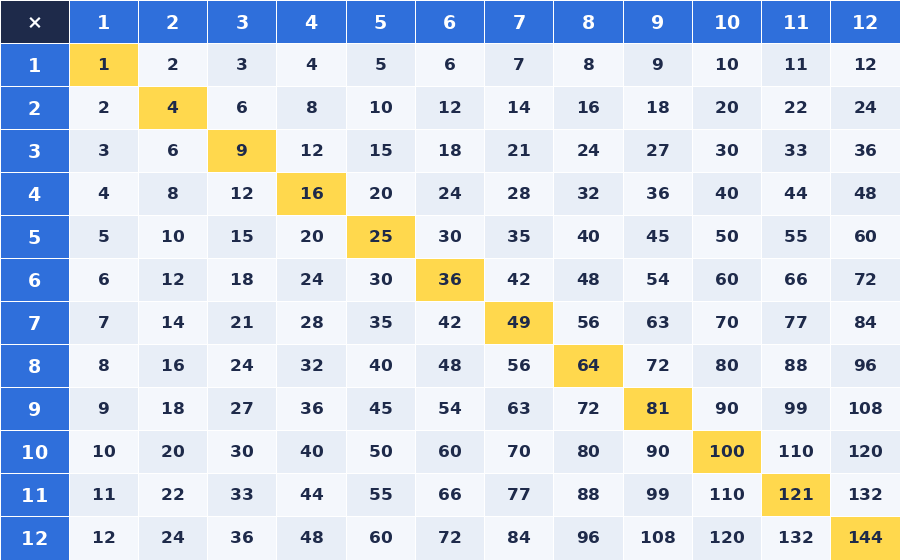
You can see all these patterns on our multiplication chart. Look at the yellow square numbers: they run in a straight line from corner to corner.
How much practice is enough?
Ten minutes a day works much better than one long session on the weekend. Short and often is the secret. Mix it up: a game one day, a few quick sums in the car the next.
When the multiplication facts start to stick, you can add some speed. Our practice page has a Beat the clock mode for that. Keep it fun, though. If a timer makes your child nervous, leave it off for now. Knowing the facts comes first. Speed comes later all by itself.
Fun ways to practice at home
Count while you walk. Skip count by 3s or 4s on the way to school: 4, 8, 12, 16 and so on.
Roll the dice. Roll two dice and multiply the numbers. The biggest answer wins the round.
Swap roles. In the car, ask each other quick questions. Let your child quiz you too. Kids love it when a grown-up gets one wrong.
Play a game. Ten minutes of one of our multiplication games before dinner. Kids usually ask for one more round.
For teachers
All our games run in the browser, so they work on school computers, Chromebooks, tablets and the smartboard. There is nothing to install and students don't need an account.
Working on one table with the whole class? Share a link with that table already picked, like this one for the 7 times table. Every student gets sums from the same table. Want the whole class to race at the same time? Try our multiplayer games.
For the classroom wall or homework folders, you can download free printable multiplication charts and blank charts on our chart page.
Safe for kids
No sign-up, no chat and nothing to buy. Kids never have to give us their name or email address to play. You can read all about it in our privacy policy. And the games themselves are friendly: no blood, no fighting and no animals getting hurt. Do you have a question we didn't answer here? Take a look at our FAQ or send us a message.